- Published on
Psychological Safety in Technical Teams: The Role of Guardrails
- Authors

Psychological Safety
Leading on from my previous article on Emotional Intelligence, this article focuses on psychological safety within technical teams and how it depends on emotional intelligence for effective conflict management.
Psychological safety was formally defined by Amy Edmondson (1999) as:
A shared belief that the team is safe for interpersonal risk-taking.
The emphasis on interpersonal risk-taking is central to understanding team behaviour and learning dynamics (Edmondson, 2018).
In practice, psychological safety is evident when individuals feel able to raise concerns, admit uncertainty, and challenge assumptions without fear of negative interpersonal consequences (Edmondson, 1999).
Why It Matters in Technical Projects
Failures in technical delivery are frequently not solely the result of technical complexity but arise from unchallenged assumptions, unvoiced concerns, and risks that are not surfaced early (Edmondson, 1999).
Research from Google’s Project Aristotle (2012) identified psychological safety as the most significant factor contributing to team effectiveness, reinforcing the importance of open communication and interpersonal trust.
As a result, teams that lack psychological safety often encounter issues late in the delivery lifecycle, when remediation is more costly and complex (Forsgren, Humble, & Kim, 2018).
Psychological Safety as the Foundation of Agile
Agile methodologies assume that individuals will communicate openly and honestly; however, this assumption frequently does not hold in the absence of psychological safety.
Core agile practices such as retrospectives, stand-ups, iteration reviews, and continuous feedback rely on candid communication and shared understanding.
Research by Forsgren, Humble, and Kim (2018) demonstrated that high-performing teams consistently create environments where information flows freely and problems are surfaced early, enabling continuous improvement.
Without psychological safety, these practices degrade into superficial activities, where individuals optimise for appearance rather than genuine learning (Forsgren et al., 2018).
Example: When technical certainty overrides human signals
An example of a cultural failure played out in the British Post Office scandal.
For years, sub-postmasters reported unexplained financial shortfalls generated by the Horizon IT system. Many were experienced operators with no history of wrongdoing.
But their reports were repeatedly discounted.
The system was treated as authoritative. The people using it were not.
The consequences were severe:
- Hundreds were prosecuted for theft and fraud
- Many lost their livelihoods, homes, and reputations
- Some were imprisoned
- Lives and families were permanently damaged
This wasn’t just a technical failure. It was a failure of leadership.
The Missing Piece: Conflict
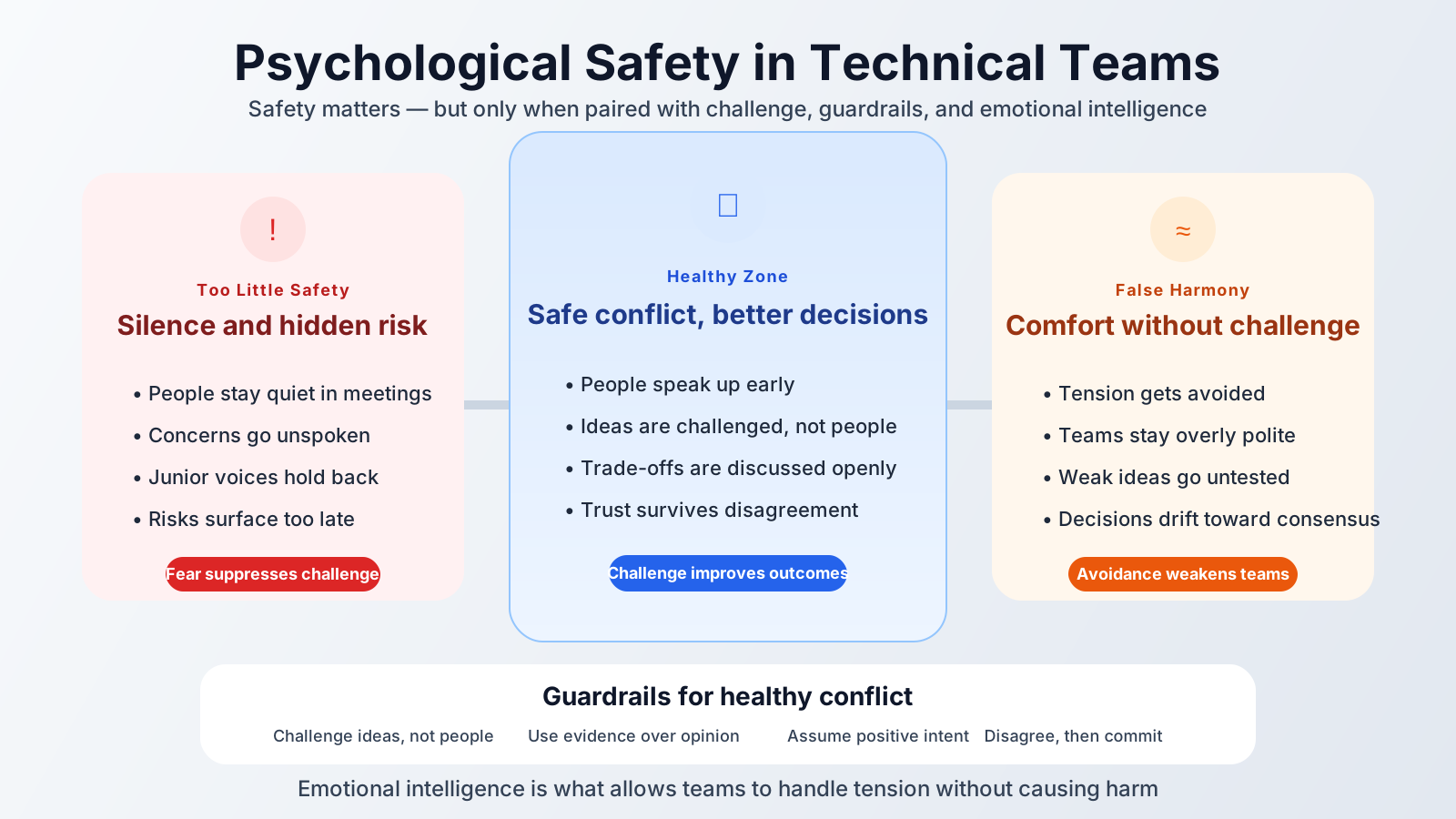
While psychological safety is often prioritised, it is frequently misunderstood as the absence of conflict.
This interpretation contradicts Patrick Lencioni’s (2002) work, which identifies fear of conflict as a key dysfunction of teams, leading to artificial harmony and reduced decision quality.
A lack of visible conflict therefore indicates suppressed dissent rather than genuine alignment (Lencioni, 2002).
Healthy technical teams engage in constructive disagreement, challenge assumptions, and debate trade-offs as part of effective decision-making processes (Lencioni, 2002).
When Safety Turns Into Avoidance
Psychological safety can be misinterpreted as a requirement to avoid discomfort or maintain constant positivity.
This misinterpretation leads to avoidance of difficult conversations, resulting in unspoken frustration, passive agreement, and suboptimal decisions.
Research by Patterson, Grenny, McMillan, and Switzler (2002) demonstrates that avoidance of high-stakes conversations reduces decision quality and negatively impacts organisational performance.
From an external perspective, teams may appear stable, while underlying issues remain unresolved and continue to accumulate (Patterson et al., 2002).
Conflict Needs Boundaries
Although conflict is necessary for effective team performance, unmanaged conflict introduces risks, including personal attacks, dominance by more confident individuals, and emotional escalation.
The importance of structured communication and disciplined disagreement is supported by leadership and organisational research (Goleman, Boyatzis, & McKee, 2002).
The objective is not to increase the volume of conflict, but to improve its quality through clear boundaries and mutual respect.
What Healthy Conflict Looks Like
Healthy conflict is characterised by structured, respectful disagreement, where ideas are rigorously examined without undermining individuals.
This aligns with established principles of team effectiveness, including trust, accountability, and constructive challenge (Lencioni, 2002).
Clear behavioural boundaries—such as focusing on ideas rather than individuals, using evidence to support arguments, and maintaining respectful dialogue—enable teams to benefit from conflict without damaging relationships.
The Role of Emotional Intelligence
The ability to engage in constructive conflict is closely linked to emotional intelligence, a concept popularised by Daniel Goleman (1995).
Emotional intelligence provides the individual capabilities required to operate effectively within psychologically safe environments, particularly in managing emotional responses and maintaining productive relationships (Goleman, 1995; Goleman, Boyatzis, & McKee, 2002).
Psychological safety establishes the environment, while emotional intelligence determines how individuals behave within it.
Self-awareness
Self-awareness involves recognising one’s own emotional responses and biases, particularly during disagreement (Goleman, 1995).
Self-regulation
Self-regulation enables individuals to manage reactions and avoid defensive or disruptive behaviour in challenging discussions (Goleman et al., 2002).
Social awareness
Social awareness involves understanding group dynamics and recognising when others may be withholding input (Goleman, 1995).
Relationship management
Relationship management supports maintaining trust and collaboration, even in the presence of conflict (Goleman et al., 2002).
Applying This in Technical Teams
The practical application of psychological safety and emotional intelligence is evident in everyday team behaviours.
Leaders who acknowledge uncertainty and actively invite challenge contribute to increased team learning and improved outcomes (Edmondson, 1999).
Structured approaches to discussion and decision-making, such as formalised design reviews and explicit consideration of trade-offs, align with modern engineering practices that emphasise transparency and continuous improvement (Forsgren et al., 2018; Skelton & Pais, 2019).
Final Thought
In complex technical environments, disagreement is inevitable due to competing priorities, trade-offs, and uncertainty.
The absence of visible conflict often indicates suppressed concerns rather than true alignment (Lencioni, 2002).
As demonstrated by Edmondson (1999; 2018), psychological safety enables participation and learning, but it must be balanced with constructive challenge to support innovation and resilience.
Psychological safety, when combined with emotional intelligence and structured conflict, forms the foundation of effective and high-performing technical teams.
References
- Edmondson, A. (1999). Psychological Safety and Learning Behavior in Work Teams. Administrative Science Quarterly.
- Edmondson, A. (2018). The Fearless Organization: Creating Psychological Safety in the Workplace for Learning, Innovation, and Growth.
- Goleman, D. (1995). Emotional Intelligence: Why It Can Matter More Than IQ.
- Goleman, D., Boyatzis, R., & McKee, A. (2002). Primal Leadership: Realizing the Power of Emotional Intelligence.
- Lencioni, P. (2002). The Five Dysfunctions of a Team.
- Forsgren, N., Humble, J., & Kim, G. (2018). Accelerate: The Science of Lean Software and DevOps.
- Skelton, M., & Pais, M. (2019). Team Topologies: Organizing Business and Technology Teams for Fast Flow.
- Patterson, K., Grenny, J., McMillan, R., & Switzler, A. (2002). Crucial Conversations: Tools for Talking When Stakes Are High.
- Google (2012). Project Aristotle: Understanding Team Effectiveness.